



2nd Annual Trust Decanting State Rankings Chart Released!
By Steven J. Oshins, J.D., AEP (Distinguished)
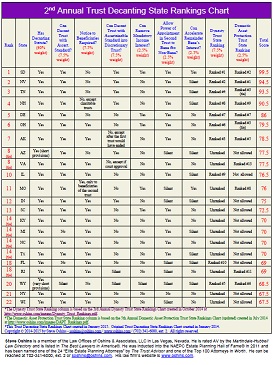
The 2nd Annual Trust Decanting State Rankings Chart was released earlier this week. This year’s chart includes more variables than were included in last year’s chart. The additional attributes were added in order to provide the end user with as many details as possible so the best jurisdiction can be selected based on the desired decanting or, with respect to a newly-formed irrevocable trust, the best jurisdiction to maximize future decanting flexibility.
What is Decanting?
Trust decanting is the act of distributing assets from one trust to a new trust with different terms. Just as one can decant wine by pouring it from its original bottle into a new bottle, leaving the unwanted sediment in the original bottle, one can pour the assets from one trust into a new trust, leaving the unwanted terms in the original trust.
For many years, practitioners have struggled to find ways to change the terms of an irrevocable trust. However, through common law and through the decanting statutes that have been enacted in many jurisdictions, it is now possible to modify an irrevocable trust. The rationale for allowing such a modification is that a trustee who has the power to distribute the trust property to or for the benefit of one or more beneficiaries should be able to make the distribution to them in trust and dictate the terms of that trust. Decanting is essentially a “do-over”.
2nd Annual Trust Decanting State Rankings Chart
The 2nd Annual Trust Decanting State Rankings Chart applies the following weights to these variables:
- Does the state have a decanting statute? [60% weight]
- Does the decanting statute allow a trust with an ascertainable standard for distributions to be decanted? [7.5% weight]
- Does the decanting statute require the trustee to give notice of the proposed decanting to the trust beneficiaries? [7.5% weight]
- Does the decanting statute allow the trustee to decant a trust with an ascertainable standard into a discretionary trust? [7.5% weight]
- Does the decanting statute allow the trustee to remove a mandatory income interest? [2.5% weight]
- Does the decanting statute allow the trustee to give a beneficiary in the second trust a power of appointment allowing an appointment to someone who wasn’t a beneficiary of the first trust? [2.5% weight]
- Does the decanting statute allow the acceleration of a remainder beneficiary’s interest so the remainder beneficiary can be a current beneficiary? [2.5% weight]
- What is the state’s dynasty trust ranking? [7.5% weight]
- What is the state’s domestic asset protection trust ranking? [2.5% weight]
The Leading Decanting States
For the second year in a row, South Dakota is ranked #1 and Nevada is ranked #2. Tennessee moved up from #4 to #3, in large part because of the additional variables applied in this year’s chart. New Hampshire and Delaware are ranked #4 and #5, respectively. These five states appear to be the leaders in decanting.
There is a drop-off after the top five states. One reason for the drop-off is that the top five states are five of the seven states that do not require the trustee to give notice of the decanting to the beneficiaries. Although the states that require notice likely do so for public policy reasons, many people do not want every beneficiary to see a copy of the existing trust and the proposed decanting trust since they want more privacy.
Summary
This year’s chart shows the material differences among the 22 jurisdictions that have enacted decanting statutes. While certain factors will be more important to different advisors and more relevant to different client situations, the chart gives advisors a starting point in deciding where to situs a new trust or where to move an existing irrevocable trust that needs to be modified.
Decanting is perhaps the most underused tool in the estate planning industry in relation to the benefits and flexibilities it provides, and likely will become more popular as more practitioners become aware of these opportunities.
REQUEST FREE CHART
ABOUT THE AUTHOR

Steven J. Oshins, AEP (Distinguished) is a member of the Law Offices of Oshins & Associates, LLC in Las Vegas, Nevada. He was inducted into the NAEPC Estate Planning Hall of Fame® in 2011. He was named one of the 24 “Elite Estate Planning Attorneys” and the “Top Estate Planning Attorney of 2018” by The Wealth Advisor and one of the Top 100 Attorneys in Worth. He is listed in The Best Lawyers in America® which also named him Las Vegas Trusts and Estates/Tax Law Lawyer of the Year in 2012, 2015, 2016, 2018, 2020, 2022, 2024 and 2026. He can be reached at 702-341-6000, ext. 2 or [email protected]. His law firm’s website is www.oshins.com.
OTHER ARTICLES IN THIS ISSUE
- RETIREMENT BENEFIT PLANNING: “The Art of Roth Recharacterizations” by Robert S. Keebler, CPA/PFS, MST, AEP (Distinguished), CGMA
- SUPPORT STAFF: “Top 10 E-mail Etiquette Rules for Estate Planning Professionals (and Their Assistants and Staff)” by Kristina Schneider, Executive Assistant
- PRACTICE-BUILDING: “Generate More Revenue This Year with More Referrals from Clients” by Philip J. Kavesh, J.D., LL.M. (Taxation), CFP®, ChFC, California State Bar Certified Specialist in Estate Planning, Trust & Probate Law
- ADVANCED-LEVEL ESTATE PLANNING: “Beware of Standard Provisions in LP & LLC Documents” by Edwin Morrow, J.D., LL.M., MBA, CFP®, RFC®