



Steve Oshins: Interview About the 2019 State Rankings Charts and State Income Tax Chart
By Steven J. Oshins, Esq., AEP (Distinguished)
While at the WealthCounsel Symposium in Boston, we at The Ultimate Estate Planner (“UEP”) had the opportunity to sit down and interview nationally-known estate planning and asset protection attorney, Steve Oshins (“SJO”). The interview consisted of a number of questions related to his State Rankings Charts and State Income Tax Chart.
UEP: Please tell us about your charts and where they can be accessed.
SJO: I currently have four charts. Three of the charts rank the states that have the best Domestic Asset Protection Trust laws, Dynasty Trust laws and Decanting laws, respectively. The fourth chart has the rules related to how each state and Washington, D.C. taxes non-grantor trusts. The charts can all be accessed on my law firm’s website. I update each chart once each year and always have the most updated version accessible at that web page.
Most of the people in the estate planning industry use my charts, so I take them very seriously each year when I update them. They get thousands of web hits every month, so I have spent tons of time perfecting them. Other trust situs marketers pass out marketing materials that suggest that their home state is the best in each and every category. Obviously, that is nonsense and useless to the consumer who is truly searching for the right trust jurisdiction. That is why I make full disclosure the key to my charts.
UEP: What is the history behind the charts? How did you come up with the idea?
SJO: This is actually a great story. And it is one that I have never publicly told until now. One of the marketers from a Delaware trust company was distributing lengthy outlines at large conferences where he (or she) was presenting. The outlines compared Delaware’s trust laws to other states’ trust laws and had so many material misrepresentations that it was bothering me and probably a lot of other people with ties to states that have superior trust laws.
So I decided to publish the 1st Annual Domestic Asset Protection Trust State Rankings Chart in 2010 where I showed the differences among all of the Domestic Asset Protection Trust jurisdictions in a handy one-page chart. It was getting thousands of web site views, so I gradually added a Dynasty Trust Chart, then a Trust Decanting Chart and finally a Non-Grantor Trust State Income Tax Chart. Needless to say, once the comparisons were put into an easy-to-read chart format, it shifted a lot of the national trust business to the states that truly have the best trust laws, most notably Nevada and South Dakota. I like to think of myself as the Trust Situs Police.
UEP: Please tell us a little about each chart.
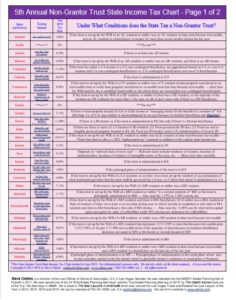
SJO: There are four charts. The first chart is the Domestic Asset Protection Trust State Rankings Chart. Domestic Asset Protection Trusts have become very popular since asset protection planning is such an important part of estate planning. The second chart is the Dynasty Trust State Rankings Chart. Since Dynasty Trusts have been the backbone of advanced estate planning for so many decades, that chart helps planners determine where to situs their long-term Dynasty Trusts. The third chart is the Trust Decanting State Rankings Chart. This chart shows the different levels of flexibility among the states that have decanting statutes that allow the trustee to distribute the assets from one irrevocable trust into a new irrevocable trust with different provisions. The fourth chart is the Non-Grantor Trust State Income Tax Chart. This chart is not a rankings chart. Rather, it is a two-page chart showing the tax rates in all states that tax trusts, along with the rules that each state applies in order to determine whether to tax the undistributed trust income.
UEP: Which of the four charts is the most valuable for estate planners?
SJO: There is no question that the Non-Grantor Trust State Income Tax Chart is the most valuable of the charts. I use it nearly every day. A sophisticated estate planner should always make informed decisions about the state income tax effects of the residency of the settlor, the trustees, and the beneficiaries, as well as the place of administration of the trusts. This chart assists the planner in knowing what it takes in each state to tax a trust. Especially with the $10,000 State & Local Tax cap, state income tax planning has been getting more and more important as a consideration in many of these decisions.
UEP: Steve, we know that you’re very busy. From speaking at various conferences in the legal, financial and tax planning industry, to helping service your clients. So, we sincerely thank you for taking the time to meet with us for this interview.
SJO: Thank YOU! I hope this will help your readers.
ABOUT THE AUTHOR

Steven J. Oshins, AEP (Distinguished) is a member of the Law Offices of Oshins & Associates, LLC in Las Vegas, Nevada. He was inducted into the NAEPC Estate Planning Hall of Fame® in 2011. He was named one of the 24 “Elite Estate Planning Attorneys” and the “Top Estate Planning Attorney of 2018” by The Wealth Advisor and one of the Top 100 Attorneys in Worth. He is listed in The Best Lawyers in America® which also named him Las Vegas Trusts and Estates/Tax Law Lawyer of the Year in 2012, 2015, 2016, 2018, 2020, 2022, 2024 and 2026. He can be reached at 702-341-6000, ext. 2 or [email protected]. His law firm’s website is www.oshins.com.
Great interview Steve. I use your charts every day as well.